
Water Reuse: What Plant Water Management Should Know in 2025
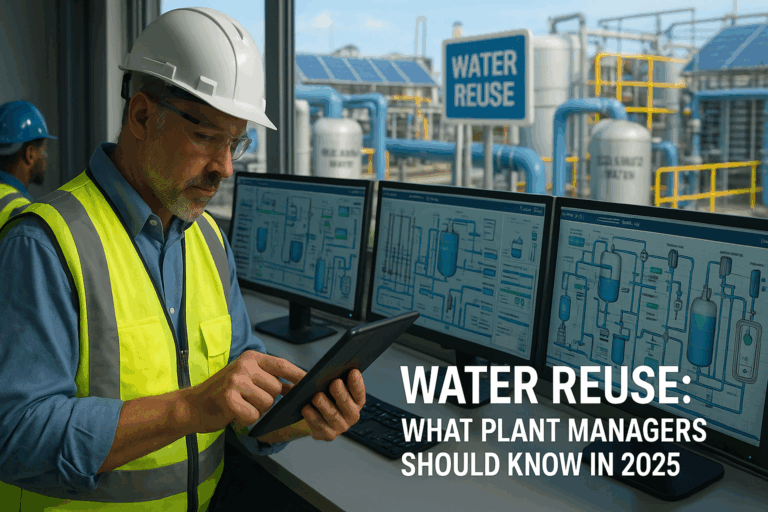
Water scarcity isn’t coming—it’s here. While your plant operates under increasingly stringent discharge regulations and rising water costs, the solution may be flowing right past your facility. Industrial water reuse has evolved from an environmental nice-to-have to an operational necessity, yet many plant managers still approach it with outdated assumptions and incomplete information.
The terminology alone can be overwhelming: water recycling versus water reuse, direct versus indirect applications, and acronyms like ZLD that sound more like military operations than water treatment processes. More critically, the gap between theory and practical implementation often leads to costly mistakes that could have been avoided with proper planning and realistic expectations.
Redefining Plant Water Management Through Water Reuse
Water reuse encompasses any process that captures, treats, and repurposes water that would otherwise be discharged as wastewater. However, this broad definition masks important distinctions that directly impact your operational decisions and capital investments.
Industrial water recycling typically refers to closed-loop systems within your facility where process water undergoes treatment and returns to the same or similar application. Think of cooling tower blowdown being treated and returned to the cooling system, or rinse water from manufacturing processes being cleaned and reused for the same purpose.
Municipal water reuse involves treating wastewater to standards suitable for non-potable applications like irrigation, industrial processes, or groundwater recharge. For industrial facilities, this often means sourcing treated municipal wastewater instead of relying entirely on freshwater supplies.
The distinction matters because each approach presents different technical challenges, regulatory requirements, and economic considerations. A plant manager evaluating water reuse options needs to understand these differences upfront to avoid pursuing solutions that don’t align with their operational reality.
The Economic Reality Behind Water Reuse Decisions
The business case for water reuse extends beyond simple water cost savings. While reducing freshwater consumption provides direct cost benefits, the real value often lies in areas that don’t appear on your water bill.
Discharge fees and penalties represent a growing expense for many facilities. As environmental regulations tighten, the cost of treating wastewater to meet increasingly stringent discharge standards can quickly exceed the cost of implementing water reuse systems. Additionally, many facilities face volumetric discharge limits that constrain production capacity—water reuse can provide the operational flexibility to maintain or expand production within existing permit constraints.
Regulatory compliance costs deserve particular attention. Zero Liquid Discharge (ZLD) requirements, while still relatively uncommon, are expanding across industries and geographic regions. ZLD systems eliminate liquid waste streams entirely, typically through evaporation and crystallization processes that recover both water and solid waste products. For facilities facing or anticipating ZLD requirements, implementing water reuse as an intermediate step can reduce the size and complexity of eventual ZLD systems.
Risk mitigation also drives water reuse adoption. Supply chain disruptions, drought conditions, and competing demands for freshwater resources create operational vulnerabilities that water reuse can address. Facilities with diverse water sources, including recycled water, demonstrate greater resilience during supply interruptions.
Technology Selection: Matching Solutions to Your Comprehensive Plant Water Management Applications
The treatment technology landscape for water reuse has expanded significantly, but success depends on matching the right technology to your specific application and water quality requirements.
Electrocoagulation has emerged as a versatile treatment option for industrial water reuse applications. This technology uses electrical current to generate coagulants directly in the water, removing suspended solids, oils, heavy metals, and other contaminants without adding chemical coagulants. For facilities dealing with complex industrial wastewaters, electrocoagulation offers several advantages: reduced chemical handling and storage requirements, smaller physical footprint compared to conventional treatment systems, and the ability to handle variable influent quality without extensive upstream equalization.
However, electrocoagulation isn’t universally applicable. The technology works best with wastewaters containing sufficient conductivity and responds poorly to high levels of dissolved organic compounds. Power consumption can be significant for high-volume applications, making energy costs a critical factor in economic evaluations.
Advanced oxidation processes, including catalytic activation technology like GCAT, address contaminants that conventional treatment methods struggle to remove. GCAT employs catalytic activation to generate highly reactive species that break down complex organic molecules, making it particularly valuable for pharmaceutical, chemical, and food processing applications where conventional biological treatment proves inadequate. This technology can be effectively combined with liquid AOP solutions like Genclean to create synergistic treatment systems that tackle both dissolved organics and enhance biological processes.
High solids self-cleaning spiral filtration systems provide continuous operation with minimal downtime for facilities dealing with high suspended solids concentrations up to 1000 mg/l. These systems use specialized spiral wire elements with integrated cleaning mechanisms that prevent fouling and maintain consistent performance even with challenging feed waters. The self-cleaning capability reduces maintenance requirements, making them particularly suitable for industrial pretreatment applications with variable solids loading requirements.
Media filtration systems using specialized materials like Natzeo and carbon media provide effective removal of suspended solids and certain dissolved contaminants. Natzeo media offers advantages over conventional sand filtration including higher loading rates, better particle removal efficiency, and reduced backwash frequency. Carbon media adds adsorption capacity for organic compounds and taste/odor control. These systems work particularly well as polishing steps in multi-stage treatment trains.
Bio-organic flocculants like Zeoturb enhance conventional coagulation and flocculation processes by providing improved settling characteristics and reduced chemical dosage requirements. Zeoturb’s liquid bio-organic formulation offers advantages over conventional polymer flocculants including better performance with variable water contaminant levels, reduced sludge production, and improved biocompatibility for downstream biological treatment processes.
Biological treatment enhancement through the utilization of Zeoturb can improve the performance of existing biological systems while reducing operational complexity. For facilities with existing activated sludge or lagoon systems, biological enhancement represents a lower-capital approach to improving effluent quality for reuse applications. Zeoturb can work synergistically with catalytic activation technologies to provide comprehensive organic contaminant removal.
Tertiary Reverse Osmosis provides the highest level of contaminant removal but requires careful consideration of pretreatment requirements and concentrate management. RO systems produce high-quality water suitable for demanding applications but generate a concentrate stream that requires disposal or further treatment. The technology excels in applications requiring consistent water quality but struggles with highly variable influent conditions without extensive pretreatment.
Common Implementation Pitfalls and How to Avoid Them
Experience across hundreds of water reuse projects reveals recurring mistakes that plant managers can avoid with proper planning and realistic expectations.
Underestimating water quality variability represents the most common technical pitfall. Industrial wastewaters often exhibit significant variations in flow rate, contaminant concentrations, and chemical characteristics. Treatment systems designed around average conditions frequently fail when faced with peak loading or unusual waste streams. Successful water reuse systems incorporate adequate equalization, redundant treatment capacity, and operational flexibility to handle variability.
Inadequate pilot testing leads to oversized or undersized systems and unexpected operational challenges. Bench-scale testing provides valuable screening information, but pilot testing under actual site conditions reveals operational issues that laboratory testing cannot predict. Plan for extended pilot testing periods that capture seasonal variations and operational cycles.
Ignoring downstream implications of recycled water can create problems in applications that performed adequately with freshwater. Even trace levels of residual contaminants can cause scaling, corrosion, or biological growth in systems not designed for recycled water. Cooling towers, boilers, and process equipment may require modifications or additional treatment to accommodate recycled water.
Unrealistic payback expectations often result from focusing exclusively on water cost savings while ignoring implementation costs, operational changes, and risk factors. Comprehensive economic analyses should include all capital costs, ongoing operational expenses, maintenance requirements, and potential savings from reduced discharge fees and regulatory compliance costs.
Regulatory compliance oversights can halt projects or require expensive modifications. Water reuse regulations vary significantly by location and application. Early consultation with regulatory agencies and thorough permit research prevents costly surprises during implementation or operation.
Regulatory Landscape and Compliance Considerations
The regulatory environment for water reuse continues evolving, with implications that extend beyond simple permit requirements. Understanding current trends and anticipating future requirements helps plant managers make informed decisions about water reuse investments.
Federal regulations provide broad frameworks, but state and local regulations typically determine specific requirements for water reuse projects. California, Florida, and Texas have established comprehensive water reuse regulations, while other states are developing similar frameworks. The trend clearly favors expanded water reuse, but regulatory approaches vary significantly.
Direct potable reuse regulations represent the cutting edge of regulatory development, but industrial applications face different requirements. Most industrial water reuse projects fall under existing wastewater discharge or water supply permitting processes, but specific applications may trigger additional requirements.
Cross-connection control receives particular regulatory attention. Systems that blend recycled water with potable water supplies must incorporate safeguards preventing contamination of drinking water systems. These requirements often mandate physical separation, backflow prevention, and monitoring systems that add complexity and cost to water reuse projects.
Monitoring and reporting requirements for water reuse systems typically exceed those for conventional treatment systems. Plan for additional laboratory testing, data collection, and reporting obligations when evaluating water reuse options for your plant water management.
Making the Decision: Implementation Framework
Successful water reuse implementation requires systematic evaluation that goes beyond simple cost comparisons. The following framework provides structure for plant managers evaluating water reuse opportunities.
Water audit and opportunity assessment begins with understanding your facility’s complete water balance. Document water sources, uses, and discharge points along with associated costs and regulatory requirements. Identify potential reuse applications and estimate water quality requirements for each application.
Technology screening should evaluate multiple treatment approaches against your specific requirements. Consider not just removal efficiency but also operational complexity, maintenance requirements, space constraints, and integration with existing systems.
Economic analysis must include all costs and benefits over the system’s expected lifetime. Factor in potential changes to water costs, discharge fees, and regulatory requirements. Consider financing options including third-party ownership and performance contracting.
Risk assessment should identify technical, operational, and regulatory risks along with mitigation strategies. Consider backup systems, alternative water sources, and contingency plans for system failures or regulatory changes.
Implementation planning requires coordination across multiple departments including operations, maintenance, engineering, environmental compliance, and procurement. Develop realistic timelines that account for permitting, equipment delivery, installation, startup, and optimization.
Looking Forward: Plant Water Management in 2025 and Beyond”
Water reuse will become increasingly important as freshwater resources face growing pressure from population growth, climate change, and competing demands. Plant managers who understand the technology options, regulatory requirements, and implementation challenges will be better positioned to make informed plant water management decisions that benefit their operations and bottom line.
The technology landscape continues evolving with new treatment options, improved performance, and reduced costs. However, success still depends on matching the right technology to specific applications and implementing systems that can handle real-world operating conditions.
Contact Genesis Water Technologies by email at customersupport@genesiswatertech.com today to discuss your water reuse requirements. Our team of experienced engineers can help evaluate your opportunities, select appropriate technologies, and develop implementation strategies that meet your operational and commercial objectives.